
You Cant Take It With You: Wills and Estate Planning for Australians
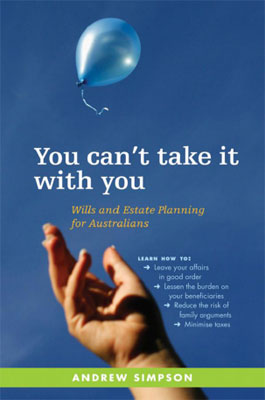
You Cant Take It With You: Wills and Estate Planning for Australians
With Australias aging population becoming larger, billions of dollars in assets will be passed on to the next generation over the coming decade, making estate planning an important consideration for baby boomers and their parents. You Cant Take It With You: Wills and Estate Planning for Australians is a comprehensive and current guide to wills and estate planning for Australians, taking the angst out of an essential financial planning step. Written in plain-English and illustrated with case studies, this is a thorough, easy to understand introductory guide to the estate planning process.
You Cant Take It With You covers all the financial, legal and human resource aspects of estate planning including wills and trusts, funeral planning, insurance and guardianship of children, readers learn how to:
You Cant Take It With You provides readers a clear idea of what the estate planning process should entail, minimising family difficulty during a trying time, and for making sure that hard earned assets are given to those they were intended.
When is the time to organise a Will?
Andrew Simpson: Any person aged 18 years and over can and should prepare a Will.
Are you ever too young to write your own Will?
Andrew Simpson: It is sensible to prepare a Will as soon as you are legally able to do so. In many cases younger adults take the view that they do not have sufficient assets to justify a Will. However, a Will does more than just distribute your estate. It also enables you to nominate a person to take control of your estate after your death. This person is called the “executor”. If no Will is prepared, then no executor is nominated. This means that no one has immediate authority to sort out your legal, personal and financial affairs after your death.
You should not assume that because you do not have significant wealth during your life time that this will be the case when you die. For example, if you have superannuation, there is also usually life insurance payable from the superannuation fund at death. Therefore, even though your superannuation contributions may be small, the life insurance component may be significant. It is for this reason that a Will should be prepared particularly if you have commenced employment and are making contributions to superannuation.
Is before you travel to another country the perfect time to organise your Will and estate?
Andrew Simpson: In many cases, a persons decision to prepare a Will is brought about by circumstances. Imminent overseas travel is one of the most common of these circumstances. Other circumstances include the death of a close friend or relative or a personal health scare.
If you dont organise a Will or plan what will happen to your estate what can happen? Does this happen a lot?
Andrew Simpson:If you die without a valid Will, your estate is distributed according to a formula set out in an Act of Parliament. Dying without a Will is called dying “intestate”. The distribution of your estate on intestacy means that you lose the ability to determine who gets your assets. There is no discretion to vary the intestacy distribution after your death. Therefore, your assets may not be distributed to your preferred beneficiaries.
A distribution on intestacy may create unwanted tax consequences and may also result in your estate passing to a beneficiary who is unable to manage it because of an intellectual disability, addiction or other circumstance. Unfortunately, many Australians die each year without a valid Will resulting in these types of consequences.
What sort of disputes can there be in regards to Wills?
Andrew Simpson: Most disputes arising from Wills result from a beneficiary being unhappy with what they receive from the Will. In this kind of case, the beneficiary may decide to challenge the Will and try and obtain a greater part of the estate. This can be very expensive for the estate. Therefore, as a Will maker it is very important to carefully consider your potential beneficiaries and the likelihood of a challenge being brought after your death. You should seek advice as to how best to protect your Will from a challenge.
Family heirlooms and personal belongings such as jewellery, paintings and antiques can also cause disputes. To avoid arguments over personal items, you may want to consider gifting specific assets to specific people in the Will to remove uncertainty regarding distributions of these types of assets.
Is the book written so everyone can understand the terms?
Andrew Simpson:[SP\SP\720998_1][SP\SP\720998_1]The book is written specifically for Australians with little or no knowledge or technical expertise in the area of Wills and estate planning. It uses case studies to explain all aspects of Wills, estate planning and powers of attorney. It is written in plain English and contains a useful glossary of terms where it has been necessary to use a legal phrase or word. It explains the process for preparing an estate plan from start to finish.
Why is it important to appoint a guardian or trustee?
Andrew Simpson: Appointing an executor and trustee of your Will ensures that someone takes responsibility for sorting out your affairs after your death. You may wish to consider a family member as your executor and trustee because they usually understand your circumstances the best. However, you may not want to burden family with this responsibility. In this case you may choose to nominate a professional executor such as a lawyer or trustee company.
If you have children under 18 years of age, then appointing guardians for these children if you die before they reach 18 is essential. You may also wish to provide specific directions in your Will regarding how your children are to be raised. These directions may relate to education, religious or cultural adherence and contact with the wider family.
Andrew Simpson is a principal of Moores Legal and heads the Estate Planning, Structuring and Superannuation Department. Andrew advises clients on the succession of personal wealth including drafting Wills and enduring powers of attorney; advising on the suitability of testamentary trusts to an estate plan and other estate related matters including estate administration and Wills disputes. Andrew regularly presents seminars and workshops to community groups and others on these topics. He is also the author of the chapter on Estate Planning in the Australian Master Financial Planning Guide published by CCH. Andrew is based in Melbourne.
You Cant Take It With You: Wills and Estate Planning for Australians
Wrightbooks
ISBN: 978 0 73140 986 0
Price: AU$34.95 / NZ$38.99


MORE
FEMALE.COM.AU
CONTACT US
FOLLOW US ON
