
Alan Alda Diminished Capacity Interview
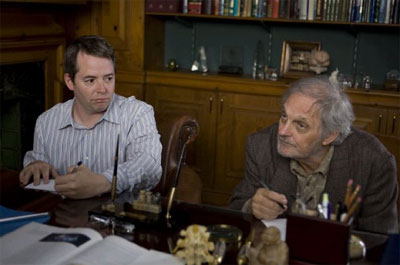
Alan Alda, Diminished Capacity Interview
ALAN ALDA'S CVAPACITY FAR FROM DIMINISHED
EXCLUSIVE Alan Alda, Diminished Capacity Interview by Paul Fischer
Alan Alda is an Emmy winner and star of one of the most iconic sitcoms in the history of television. Off screen, he is warm, affable, unpretentious and genius humbled by his acclaim. He picks his roles with care, after all he doesn't have a need to work, but as the grandfather with somewhat diminished capacity in the comedy of the same name, Alda remains every bit the scene-stealing movie star.
The film premiered during this year's Sundance Film Festival, which is where Paul Fischer was granted this exclusive audience with a comedy legend.
Paul Fisher When you read this part, did you want to make sure that it was not going to be a cliché of a character, who was in that predicament?
Alan Alda: Yeah, absolutely. And what made me want to do was that it was there in the script, it wasn't anything you had to do about that. I thought that the character was presented with respect for the character. What I most loved about it was that to me it was a story about a guy who was fighting to maintain control over his own life, even though the people around him found him inconvenient and they wanted to shovel him off to someplace else, and he wasn't going to stand for it. I really loved that effort, that struggle to control his own existence.
Paul Fisher How do you, as an actor, play a part like that without resorting to cliché? Where's the balance?
Alan Alda: I think, you know, real life has so much texture to it, there are so many unexpected things in it. If you try to find out what is genuine about the background and the predicament of the person you're playing--and don't leave out the stuff that doesn't serve the entertainment values, or doesn't seem to serve the entertainment values--then you're more likely to get into the things that are non-stereotypical, that are actually representative of the way a person lives, and in fact that turns out to support the entertainment values even better. Better than if you just glided across the surface of, oh, I know how this is; I know what kind of a person this is, ain't that funny? On the contrary, if you go underneath that a little bit, and find out what they're going through in their lives for real, it's not going to be stereotypical and it's going to show you the person from a few points of view. You see a more three-dimensional look at the person And I think Terry Kinney, who directed this, was looking for that all the way through the movie with all the characters. And when we screened it last night here at Sundance, and this morning at 8:340, same thing, same reaction, the people were involved with these characters, all the way through to the last couple of seconds of the movie. They were still laughing at character traits, not at jokes, you know? That meant to me that we had managed to do what I was trying to describe a second ago, which was to find out what's, what they're really going through rather than say, "Well, we know what it is. Because it's clear from the surface what it is." Which leads you into stereotypes.
Paul Fisher Did you base it on anyone? On your own father, for example?
Alan Alda: No. No, I didn't. I think I did more of what it's like what I would be, what I would go through.
Paul Fisher Is that what you would go through?
Alan Alda: Well the funny thing is, you know what, I don't strive for this kind of thing, but I actually was forgetting things while I was making the movie, while I was playing this part I can't remember where my car keys were. And I didn't like that! [LAUGHING] But it just sort of was a byproduct. My wife said, I can't wait till you play another guy here; I'm getting tired of this! It does kind of take over. When you concentrate really hard on something like that, it seeps into your life, and your life seeps into the character, which is ideal, if you can't tell where the border is, and you're crossing it constantly, all the time.
Paul Fisher At this stage in your life you seem to be finding rich roles to play? Are they increasingly difficult to find, and how picky are you?
Alan Alda: I'm pretty picky. I first of all, I have these two basic rules I go by, and I'm lucky enough to be able to afford to do this. I won't be in a movie if I don't think I would like to go see it. It sounds simple minded, but a lot of people are in movies they wouldn't want to go see. You know, that actor who was, Peter Lorrie talked like this, in the Warner Bros. movies. He never saw the movies, he said, in print, "They pay me to make 'em, not to look at 'em." Well I can afford to be in movies that I'd like to go see, I don't want to spend weeks or months making something that I wouldn't want to sit through for two hours. The other thing is, I really love it if I can find something that makes me wonder if I'll be able to do it. It's just a little bit past what I feel comfortable doing, so I have to work extra hard, I have to really concentrate on it and see if I can deliver the goods. And in a situation like that, when it's all over and I feel I have been able to deliver the goods, then I feel like a million bucks. That keeps me alive, that keeps me interested. If I can accomplish those two things--see then I won't be going for a stereotype. If it's really something I've not done before, and I haven't seen anybody else do it before, all I have to go on is life. I can't do what I've done before, which makes me glad, because I don't want to keep doing what I've done before.
Paul Fisher What about as a writer/director. Apart from the writing/directing in MASH, obviously, you made some wonderful films in those days. /Four Seasons/, for example. Would you have ever considered going back to that, and why did you stop being a feature director?
Alan Alda: I didn't have a great time the last time I directed.
Paul Fisher You were described at the premiere last night here at Sundance as iconic. I'm just wondering how that label fits with you, because you don't strike me as the kind of guy who likes that kind of thing.
Alan Alda: Of course not. That's always meant as a compliment, so it's better than saying, "A sack of crap," you know? But it doesn't really get me to anything; it doesn't help me in my work. The only way it does, I suppose, is I have enough recognisability that people want to put me in things, and that's of course a tremendous boost to being able to do thing you care about.
Paul Fisher Are you shocked that MASH was the kind of success it was and still is?
Alan Alda: Yeah. It's amazing. I don't understand it, I don't think anybody does. It's just one of things amazing, once in several lifetimes event that took hold. All of us were very lucky to be involved in it, and we all knew it, we all knew how lucky we were, and nobody tried to make his own, or her own thing. We all knew it was something bigger than us.
Paul Fisher When you guys had that reunion for the 25^th , something like that, how weird was that?br>
Alan Alda: Oh, not at all. We stayed friends, and we all get together and have dinner once in a while and make fun of one another and laugh. We just did it on camera that time. It was just sitting around having fun and telling stories. But it is interesting, every once in a while to realize how long ago it was. We went on the air in '72 and we went off the air in primetime in 1983, so that's a long time since we went off in prime time. There are people who weren't born when we went off the air in CBS, ten-year-old kids coming up to me saying I watch it every day. Grannies in their nineties. That is really amazing. It's sort of timeless, partly because even when we did it, it was about a time 25 years earlier, so it ages because it was ageless to start with, you know what I mean? We weren't tied down to a certain look. It doesn't look like a show that was made in the 70s, because we were trying to make it look like the 50s. So there are a lot of things that contribute to it, but mainly I think it was because we did stories about people that really lived. Those people in the MASH units really went through hell, the patients and the doctors and the nurses. We tried to tell their stories, certainly with comic invention. It wasn't a documentary, but we based many of our episodes on what the people really went through.
Paul Fisher Your most recent TV series was /West Wing/.
Alan Alda: I had a wonderful time on that, they're really wonderful people who worked on that. Anything that gives me a chance to get better at what I do makes me interested to do it, and happy to do it. I do manage to get a little better every year, so that keeps me going.
Paul Fisher What are you doing next, do you know?
Alan Alda: Well, I made three movies this year. I was in one, this one, /Diminished Capacity, /and a picture that Rod Lurie directed and wrote called /Nothing But The Truth/, very interesting story about journalism and I did a very small part in a picture called /Flash of Genius/, because it was a wonderful script, and I think Greg Kinnear is terrific and I wanted to work with him in that. And I'm just in a couple of scenes, but that's this wonderful chance I have to do whatever I want to do. I don't care, I have no career to worry about, I don't have to say, "Oh, is that too small a part?" Or, "Is it the wrong picture for me?" I don't care about that. I just want to have fun. This one makes me so happy. I'm sitting with the audience, last night, and for a couple of minutes for the end today I dropped in to listen to it, to listen to their reaction. It made me so happy to see that we gave them something that they enjoyed. We worked hard, and it was like preparing a meal for friends, you know? You want them to have a good time. You want the conversation to be good. You want them to go home feeling that they haven't wasted their time. And it made me feel just terrific to get that impression last night and this morning.
Paul Fisher Are you going to continue to write your memoirs?
Alan Alda: I have two best-selling books. I have to live a little bit more before I can write more about that. But yeah, I love to write, so there will be another book, but I'm not sure when or what it will be about.
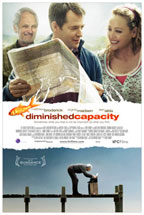
Diminished Capacity
Starring: Matthew Broderick, Virginia Madsen, Alan Alda, Louis C.K., Jimmy Bennett, Jim True-Frost, Dylan Baker, Bobby Cannavale, Jeff Perry, Lois Smith, Tom Aldredge
Director: Terry Kinney
Genre: Comedies
Runtime: 1 hr 32 mins
After a concussion leaves him unfocused, short on short-term memory, and demoted from the political pages to the comics, Cooper (Matthew Broderick), a Chicago newspaper editor, travels home to... After a concussion leaves him unfocused, short on short-term memory, and demoted from the political pages to the comics, Cooper (Matthew Broderick), a Chicago newspaper editor, travels home to Missouri to visit his aging Uncle Rollie (Alan Alda).
On the verge of losing his home and exhibiting signs of senility, Rollie spends his time stubbornly refusing to pay bills, compulsively drying socks, and sitting by the lake editing "fish poetry" (think typewriter keys tied to baited fishing lines). But when he shows Cooper a near-mint-condition Frank "Wildfire" Schulte baseball card, the two muddled men... along with Cooper's high school sweetheart, Charlotte ( Virginia Madsen)--drive back to Chicago hoping to sell the antique card at a memorabilia convention.
Director Terry Kinney and screenwriter Sherwood Kiraly (who also wrote the novel) have concocted a delightful, bittersweet comedy about people coming together and memory falling apart.
Full of wit and observant character humor, Diminished Capacity is cleverly set in the world of baseball cards and commercialized nostalgia that allows us to explore the value of our memories (which may not be what's quoted in the price list) and who we are without them. It's with a hint of melancholy that we accept that our memories are fleeting, or as Rollie's fish point out in one of their more-accessible poems, "Time is the guest of the north." They may be on to something.


MORE
- Viggo Mortensen The Road
- 24 Cast Reunion
- Aaron Eckhardt No Reservations
- Aaron Eckhart The Dark Knight
- Adam McKay Step Brothers Interview
- Alan Alda Diminished Capacity Interview
- Alan Alda Diminished Capacity Interview
- Alex Dimitriades
- Al Pacino Oceans 13
- Alan Rickman Snow Cake
- Alan Rickman Sweeney Todd
FEMALE.COM.AU
CONTACT US
FOLLOW US ON
